What is a net of a cube?
A net of a cube is a flat arrangement of six equal squares that can be folded into the six faces of a cube. Each shared edge acts as a hinge. A successful net covers every face exactly once: no square overlaps another face, and no face is left uncovered. “Cube net,” “cube nets,” and “net of a cube” describe the same geometric idea. The difficult part is tracking connections while the drawing changes from two dimensions to three.
Start by separating two questions. First, can this arrangement fold into a cube at all? Second, where will a particular face end up? A drawing may contain six connected squares and still fail the first question. If you assume it is valid too early, its labels can tempt you into inventing an opposite pair that the shape cannot support. Check the arrangement before interpreting decorations, numbers, or letters.
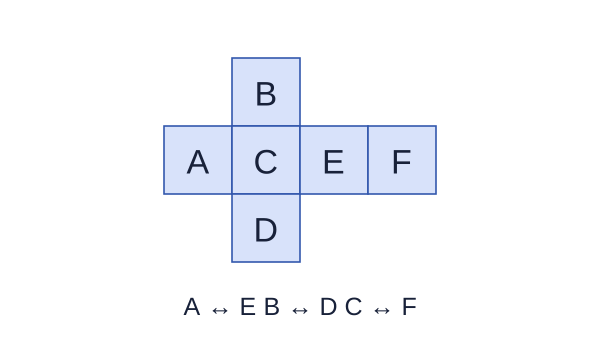
A four-step check for opposite faces
- Choose a base. Hold C still. A, B, D, and E share an edge with C, so they fold into its four neighbouring walls.
- Follow the belt. The row A–C–E–F wraps around the cube. Imagine turning each hinge by a right angle, rather than sliding the squares across the page.
- Pair the faces. A and E face in opposite directions; C and F do too. B and D close the remaining top and bottom.
- Check adjacency. Opposite faces never share an edge. If your proposed pair shares an edge in the drawing, reject it.
This four-face belt is a useful shortcut when a straight row of four exists. Moving two positions along that belt reaches the opposite face. The shortcut is specific to the belt, not to any path containing four squares. A bent path may turn around different axes, so “two steps apart” is not a universal rule. Some of the eleven cube nets have no straight four-square belt; for those, follow the hinges from a chosen base one face at a time.
In the tool, selecting a letter marks that face in solid blue and its opposite with a dashed outline. Select C, then fold: F moves to the back. Select B and unfold: D appears across C on the paper, but it will close the bottom while B closes the top. The pair readout supplies the same information in text, so you can use the example without relying on the animation or colour alone.
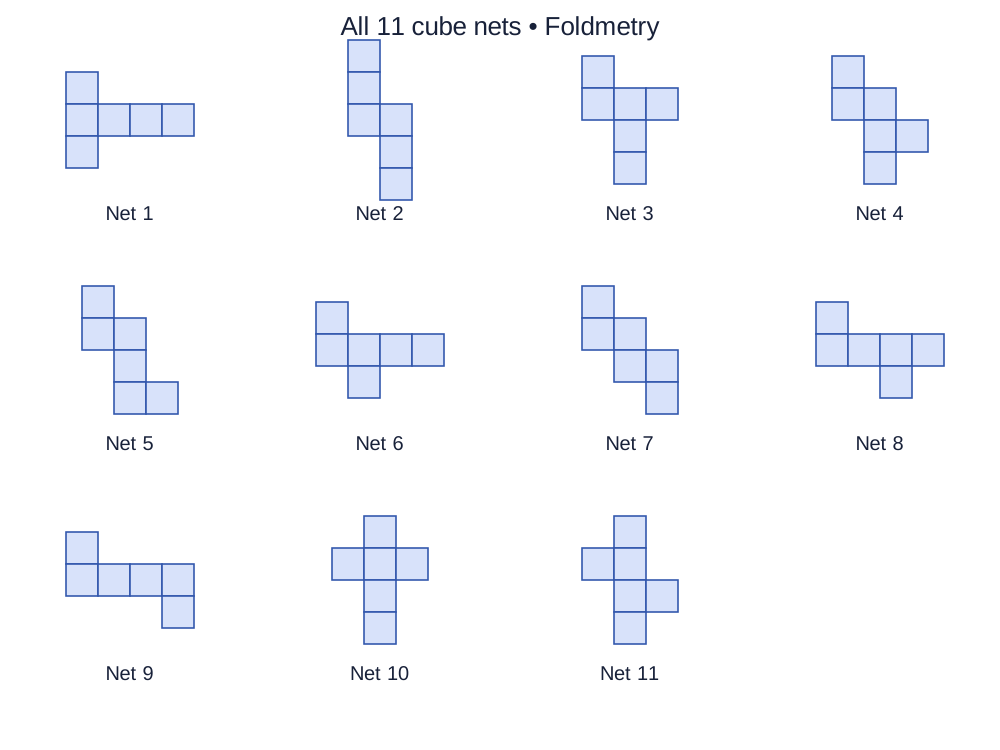
All 11 cube nets
There are eleven distinct cube nets when drawings that differ only by rotation or reflection are counted as the same shape. Turning a drawing sideways, flipping it over, or relabeling its faces does not create a twelfth net. The gallery below shows one representative of each arrangement. Equal square sizes and edge-to-edge connections matter; corners touching alone do not create a hinge.
Download all 11 cube nets as a printable SVG. Print with equal horizontal and vertical scale, add your own tabs outside the six faces, and fold along the shared edges.
To explore a net on paper, mark one square as the base and lightly label its neighbouring faces. Fold those neighbours up before closing the last face. If you add glue tabs, keep them outside the squares: a tab is a fastening aid, not a seventh face. Physical models are especially useful for explaining why two drawings with very different outlines can represent the same final cube.
Why six squares can fail
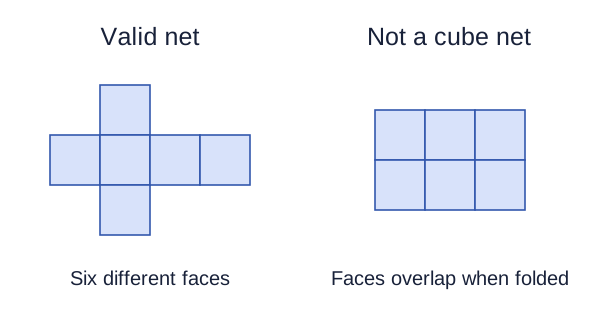
The two-by-three rectangle is a common trap. Its squares are connected and its area equals the area of a cube’s surface, but the shared edges cannot all fold into six different faces. A two-by-two patch within it creates a closed loop of hinges. Following that loop assigns incompatible directions to the same square. Cutting the correct extra edges can unfold a cube into a net, but an uncut rectangular patch is not already that net.
A straight row of six also fails: a belt of four already wraps all the way around, so later squares return to faces that are occupied. Two flaps can fail if they fold toward the same remaining face. Look for overlap in three dimensions, not merely overlap in the flat drawing. If you cannot follow the fold consistently, use a physical model or assign front, back, left, right, top, and bottom as you go.
A worked opposite-face question
Which face is opposite C?
In A–C–E–F, hold C as the front. E folds to the right side; the next face F turns once more and closes the back. Therefore F is opposite C. A closes the left side, B the top, and D the bottom.
Notice how little you need to remember. You do not need the exact viewpoint used by the finished-cube animation. A camera can turn around the cube, making its front appear on the left of your screen, but the opposite pairs stay A/E, B/D, and C/F. Label relationships are properties of the object; “left on the screen” is a property of the current view. This distinction also helps with perspective-taking questions.
Try explaining why each wrong answer fails. A, B, and E each share an edge with C in the original net, which immediately rules them out as its opposite. D shares an edge with C too. Eliminating direct neighbours leaves F, and following the belt confirms it. Using both checks is more reliable than memorizing this one picture, because a new question can rotate the drawing or replace the letters.
How to practice without memorizing a picture
Begin with a blank net, label the base, and predict all three opposite pairs before folding. Next, rotate the paper by a quarter turn and solve again without moving the labels. Finally, change the net itself. This progression separates a geometric method from recognition of a familiar outline. When you make a mistake, write down the hinge at which your imagined face moved in the wrong direction.
Cube folding connects naturally with mental rotation, which preserves the object while changing its orientation, and paper folding, which tracks layers and reflections. For a mixed set containing nets, viewpoints, and block counting, try the free spatial reasoning test. The short web exercises provide worked explanations; Foldmetry on iPhone and iPad adds guided lessons, repeated practice, and local mistake review.
Take the method into daily practice.
Foldmetry on iPhone and iPad brings six spatial skills into 36 guided lessons, daily practice, and local mistake review. Free to start, with optional Pro features.
Download on the App Store