What a paper folding test measures in a question
A paper folding test typically asks you to follow a sequence of folds, holes, or cuts and predict the result after the paper is opened. The page may look like a simple square, but the folded packet contains layers. A punch can pass through several layers and create several positions on the opened sheet. Your job is to track those positions through each fold, rather than counting visible dots in the folded drawing.
Read the instructions before starting. Identify which half moves, where each crease lies, and whether a punch passes through all layers. Those conditions determine the result. A diagram with one visible dot is not enough if the question leaves the layers or fold direction unspecified. In the examples here, folds are exact half-folds and the punch passes through every layer of the folded packet. We also state when a hole is away from a crease.
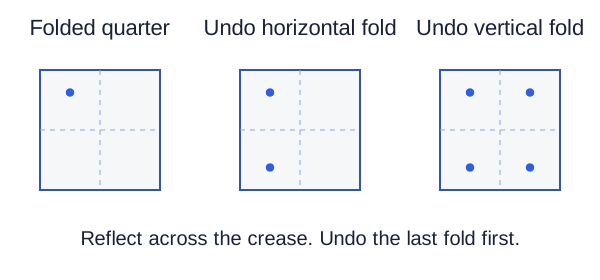
A four-step unfolding method
- Record the folds. List the moving half and crease for each fold, in order.
- Mark the punch. Locate it relative to the creases and outer edges of the surviving packet.
- Undo the last fold. Reflect every current hole across that crease.
- Continue backwards. Undo the earlier folds, then check symmetry and coincident positions.
Reverse order matters. If the right half folds left first and the bottom half folds up second, undo the horizontal fold first. Reflect each current position into the lower half; then reflect both resulting positions into the right half. For these perpendicular half-folds, the final result happens to be symmetric across both creases, but that does not make arbitrary unfolding order safe in more complicated fold sequences.
Use distance from a crease as your anchor. A hole one unit to the left of a vertical crease produces a partner one unit to its right at the same height. A horizontal crease changes height while keeping the horizontal position fixed. Treating reflection as a quarter turn is a common error: a turn can preserve the distance from the centre while putting the hole in the wrong place relative to the crease.
Worked example: two folds and one punch
Four positions from one punch
Use a square with coordinates from 0 to 4 in each direction, with y increasing downward. Fold the right half left across x=2, then the bottom half up across y=2. Punch at (1, 0.75) in the surviving upper-left quarter. Opening gives (1, 0.75), (1, 3.25), (3, 0.75), and (3, 3.25).
The first unfolding changes y to 4−y, so 0.75 becomes 3.25. The second changes x to 4−x, so 1 becomes 3. Both reflections preserve the other coordinate. This verifies the placement as well as the number of holes. Four dots in the wrong corners are still an incorrect answer. The two holes near the top stay equally far from the vertical crease, and their lower partners stay equally far from the horizontal crease.
The punch is deliberately inside the quarter, away from both crease lines. Its reflected copies are distinct, and every folded layer receives the punch. If a hole lay on a crease, reflection could send it to the same position, so counting four layers would not automatically establish four distinct positions. Questions about boundary cuts can create joined shapes rather than isolated holes, which need a separate outline check.
When doubling the holes works
For exact half-folds, each unfolding can double the number of positions when the holes are off the crease and their reflected copies do not overlap existing holes. Under those stated conditions, one hole after one fold becomes two, and one hole after two folds becomes four. This is a conditional shortcut, not a universal rule about every paper puzzle. It answers the number question but still does not tell you where the holes go.
Before doubling, ask whether a reflected position is new. A punch placed on a crease is its own reflected position. Several original punches can also produce coincident copies after unfolding. A partial fold may create regions with different numbers of layers, and a punch through only the top layer behaves differently from a punch through the whole packet. If the item does not specify these details, describe the assumption instead of presenting a certain count.
To check an answer pattern, count the distinct holes, then inspect symmetry. For the perpendicular half-fold example, each hole has partners reflected across x=2 and y=2. A candidate with all four holes concentrated in one corner fails that reflection check even though its count is four. A candidate with two correctly placed holes may have stopped after only one unfolding. Naming the omitted step makes the error easier to fix.
Holes, cuts, and changing outlines
A circular punch away from an edge produces small holes. A cut touching an outside edge produces a notch, and a cut touching a folded crease can open into a larger connected shape. Track the cut’s outline through the same reflections you would use for a point. Then join coincident boundary segments where the paper opens. Do not assume that every visible cut will become a separate closed hole.
For example, a small triangular notch cut into a folded edge can become a diamond-like opening when the two sides are reflected and joined. Its exact shape depends on the cut and the crease. A notch in an outer edge instead produces a mirrored pair of edge notches. Sketching the cut before and after one unfolding is often clearer than trying to jump straight to the final sheet.
These paper problems differ from cube nets. A cube net wraps connected faces into a solid, while paper folding stacks parts of the same sheet on top of one another. They share the need to track hinges, but a cube’s opposite-face shortcut does not locate paper holes. Likewise, a mental rotation turns an object without creating the reflected copies caused by opening a layered sheet.
How to practice and review mistakes
Begin with one vertical fold and draw the partner hole before looking at answer choices. Add one horizontal fold only when that reflection is reliable. Use paper models for a few examples: mark crease lines, punch with a pencil tip if appropriate, and open the packet carefully. Compare the physical pattern with your prediction. This gives direct feedback about placement without relying on a memorized set of options.
When an answer is wrong, classify the error. Did you undo the folds in the wrong order, reflect across the wrong line, lose a layer, or count coincident positions twice? Redraw just that step before retrying the whole sequence. To connect paper folding with other visual methods, try the free non-verbal reasoning test or the spatial visualization test. The scores describe only these exercises; the explanations are the part to carry into your next problem.
Take the method into daily practice.
Foldmetry on iPhone and iPad brings six spatial skills into 36 guided lessons, daily practice, and local mistake review. Free to start, with optional Pro features.
Download on the App Store