What this spatial reasoning test covers
Spatial reasoning involves keeping track of shapes, directions, and relationships as you rotate an object, fold a sheet, or change your viewpoint. A spatial visualization test asks you to picture those changes before you see the result. In this free spatial ability test, work through eight original questions, with diagrams and explanations for every item.
You will meet two rotation questions, cube opposites, net validity, a paper-hole pattern, a front view, block counting, and a cross section. The set is untimed. It is a learning exercise rather than a validated psychometric instrument: its score is a count of correct answers here, not an IQ estimate, percentile, hiring result, or school assessment prediction. No account is needed and answers stay in your browser.
Four methods to use across the set
For rotations, keep connections fixed and turn the entire object. Choose a landmark and check a second branch. For cube nets, follow shared edges as hinges and distinguish adjacent from opposite faces. For paper folding, undo folds in reverse order and reflect every hole across the crease. For a front view of solid block columns, take the tallest stack along each line of sight.
Each method has conditions. A four-face belt shortcut applies to a straight belt in a valid cube net. Doubling holes assumes distinct reflected positions and a punch through every relevant layer. Adding column heights assumes the stacks are solid from the ground. A front silhouette uses an orthographic view. The wording of these conditions is part of the problem, not a minor detail to skip.
Cross-section questions ask about the intersection of a solid with a plane. In this set, the cutting plane is parallel to a face of a cube and passes through its interior, so the section is a square. A differently oriented plane can produce another polygon. Always identify the direction of the cut before reaching for a memorized answer about the solid.
Reading your result without overinterpreting it
A correct answer shows that your method worked on one item. An incorrect answer tells you to inspect that transformation. It does not establish a general weakness, and a high score does not establish a standardized level of spatial ability. The set is small, its question mix is fixed, and a repeat attempt is affected by prior exposure. Use the detailed feedback to choose what to learn next.
Try reviewing without the diagrams first: can you state why the answer follows from the conditions? Then draw the missing step. A cube question may need one hinge turn; a paper-folding question may need one reflected pair; a viewpoint question may need one maximum-height calculation. Reconstructing that step is a useful way to discover whether the error came from geometry, the instructions, or a rushed choice.
Choose a guide for your next practice
Use mental rotation for angles, landmarks, and reflections. Use the interactive cube net tool to inspect all opposite pairs and the eleven distinct nets. Read paper folding for layers, holes, and crease symmetry. The perspective-taking guide covers front and top views plus a worked block count.
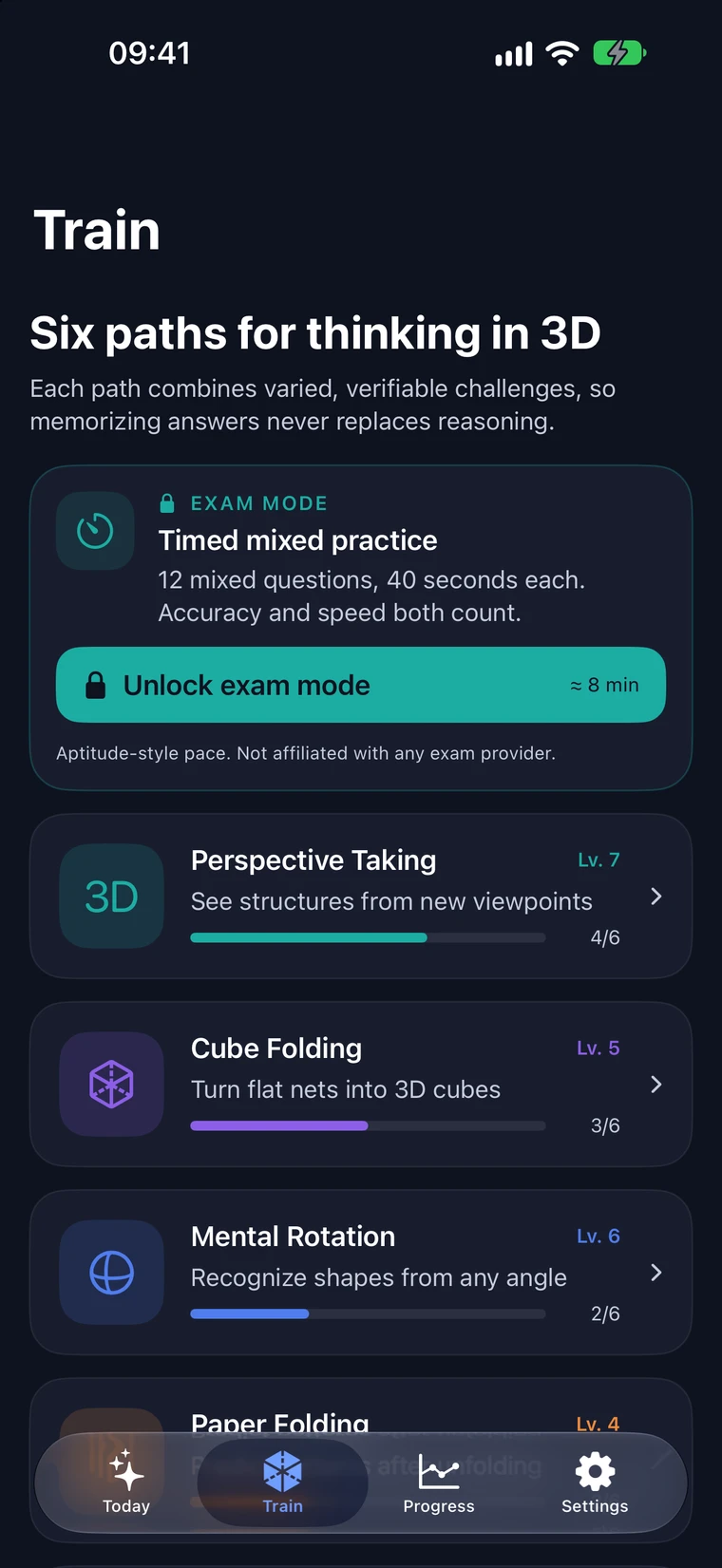
For sequences and classification, continue with the non-verbal reasoning test. If you are looking specifically for CAT4 information, read the CAT4 guide and the publisher’s advice before treating any online mini test as preparation. Foldmetry on iPhone and iPad extends general spatial learning with six skill paths, guided lessons, and mistake review; it remains a practice tool with no official examination affiliation.
Take the method into daily practice.
Foldmetry on iPhone and iPad brings six spatial skills into 36 guided lessons, daily practice, and local mistake review. Free to start, with optional Pro features.
Download on the App Store