Independent learning exercises. Foldmetry is not affiliated with GL Assessment. These are not official CAT4 items or a full mock test. The publisher advises against advance CAT4 practice.
What CAT4 is, and what this page provides
CAT4 is the Cognitive Abilities Test Fourth Edition, developed by GL Assessment for schools. It looks at reasoning with words, numbers, shapes, and spatial images. The publisher describes four batteries: verbal reasoning, quantitative reasoning, non-verbal reasoning, and spatial ability. See GL Assessment’s explanation of the batteries for the official scope.
If you are searching for a CAT4 practice test ahead of a school assessment, read the publisher’s guidance first. GL Assessment advises against advance practice or coaching for CAT4, because it can affect the reliability of the results. The formal assessment includes its own introductory practice examples. Questions about an upcoming assessment should go to the school, which can explain its process.
This page offers six original, untimed visual exercises for general learning. They cover shapes, patterns, rotation, folding, and cube relationships. They are independent Foldmetry puzzles, not official CAT4 questions, not a reproduction of the test, and not a full simulation of its four batteries. Use them to discuss visual methods at your own pace rather than as a prediction of a school assessment score.
What the practice score can tell you
The result is simply the number of these six questions you answered correctly. It does not produce a CAT4 Standard Age Score, percentile, stanine, IQ, pass mark, or indication of school eligibility. There is no comparison group or age norm behind this mini set. Reading an explanation and trying again can help you learn the method, but the second score is also affected by remembering the questions.
For a useful review, describe your reasoning before opening the solution. Did you track a rotation angle, recognize a sequence rule, or reflect a hole across a crease? If you guessed correctly, the method still deserves a second look. If you answered incorrectly, the explanation identifies a concrete transformation to check. These observations are more informative for learning than attaching a broad ability label to six answers.
Guidance for families
Keep a general shape activity relaxed. Let a learner draw, explain, or use a paper model rather than insisting on speed. If they are about to take CAT4, follow the school’s and publisher’s guidance about familiarisation instead of setting a drilling schedule. The official introductory examples are designed to explain the response format during the assessment.
CAT4 and an 11+ entrance examination are not interchangeable. Schools and assessment providers can use different formats for different purposes. This web page does not establish which assessment a school uses or whether outside preparation is appropriate. Ask the school about its actual process. Foldmetry’s wider practice is for learning spatial methods and enjoying visual problems, with no promise about entrance outcomes.
Continue with a particular skill
For a deeper explanation, read the mental rotation guide, try the interactive net of a cube, or follow the paper folding examples. The non-verbal reasoning test focuses on patterns and visual relationships. The spatial reasoning test adds viewpoints, block counting, and a cross section. All are original, free browser exercises with transparent explanations.
Take the method into daily practice.
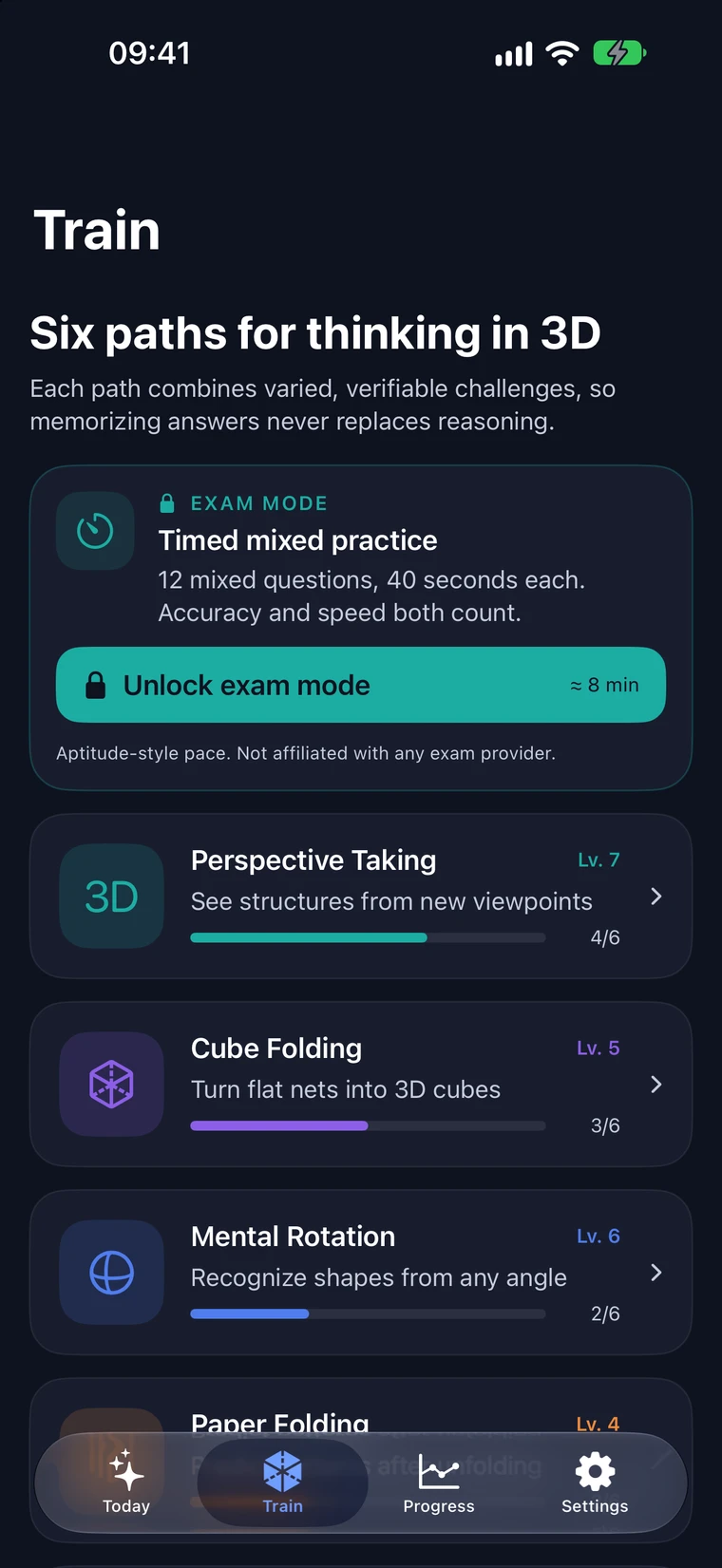
Foldmetry on iPhone and iPad brings six spatial skills into 36 guided lessons, daily practice, and local mistake review. Free to start, with optional Pro features.
Download on the App Store