What is non-verbal reasoning?
Non-verbal reasoning uses relationships between visual shapes and patterns. Typical tasks involve sequences, matrices, classification, rotation, and reflection. Instead of choosing a word or solving a written arithmetic expression, you infer a rule from the diagrams. “Non-verbal” does not mean that instructions disappear: you still need to understand whether the question asks for the next item, a missing cell, or a shape with a stated property.
This free non-verbal reasoning test contains eight original learning questions. It is untimed and gives an explanation for every answer. The set is not an official 11+ paper, CAT4 assessment, or standardized ability test. It has no age norms, percentile conversion, or passing threshold. You can use it as a short introduction to visual methods without downloading an app or creating an account.
A method for finding visual rules
First identify what changes: the number of elements, their orientation, their position, their fill, or the relationships between them. Check one candidate rule against every given step. For a matrix, test both rows and columns. The missing cell should satisfy all the visible constraints, not just resemble its nearest neighbour. If a simple count rule explains the full grid, do not invent a complicated transformation without evidence.
Then separate transformations from properties. Rotating a triangle changes its direction but preserves its three sides. Reflecting an asymmetric shape can preserve the number of squares while reversing their arrangement. Counting only one attribute is therefore enough for a stated side-count question but not enough for a rotation-versus-reflection question. Read what the task asks before selecting the feature you will compare.
Finally, predict an answer before scanning the options. If the arrows turn clockwise by a quarter turn, say which direction comes next. If each matrix step adds one dot, state the missing count. This prevents a visually attractive distractor from becoming your rule after the fact. Use the choices to confirm a prediction, then explain why at least one competing answer fails.
Using explanations to review a result
The score tells you how many items in this particular set were correct. A pattern question and a paper-folding question can fail for different reasons even when they contribute equally to that total. Review the transformation you used: a count increment, a consistent turn, a reflection across a crease, or an invariant such as the number of sides. Repeated guessing on the same page mainly measures recognition of answers.
For a new example, sketch your own pattern with the same rule and ask whether another person can identify it. Keep the rule consistent across all steps. For folded paper, physically unfold one example to check where the holes land. For an asymmetric shape, trace its branches to distinguish a turn from a reflection. These checks connect an answer to observable geometry rather than to a memorized letter.
Take the method into daily practice.
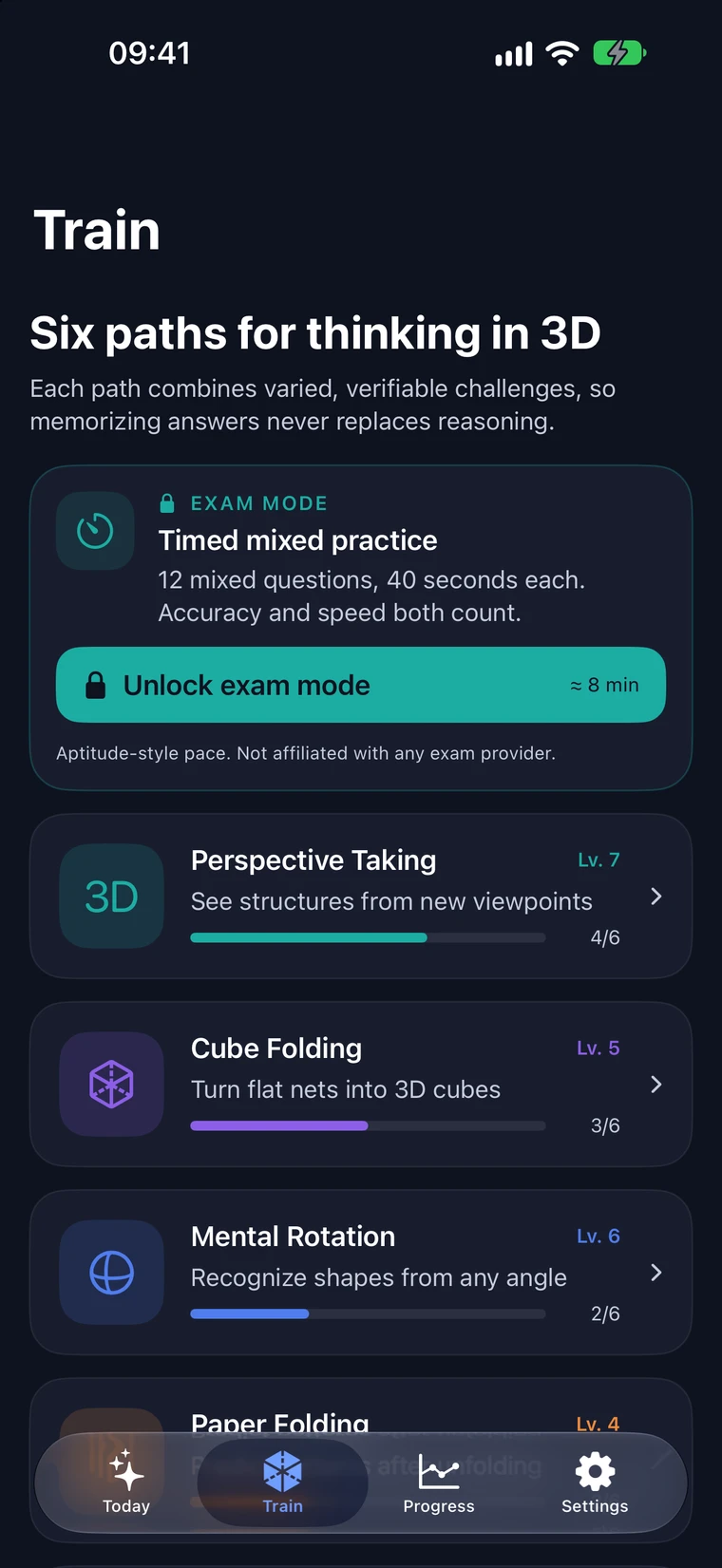
Foldmetry on iPhone and iPad brings six spatial skills into 36 guided lessons, daily practice, and local mistake review. Free to start, with optional Pro features.
Download on the App Store