What a mental rotation test asks you to do
Mental rotation means recognizing or predicting an object after it turns. A mental rotation test may show flat asymmetric shapes, drawings of three-dimensional blocks, or labeled objects viewed from another direction. Your task is to keep the object’s structure fixed while changing its orientation. A shape rotation test is the two-dimensional version: you turn the entire drawing within its plane. Neither task gives permission to detach a piece or reflect the object.
A useful starting question is “What must stay the same?” A rigid turn preserves the number of parts, their connections, lengths, and angles. It also preserves the handedness of a genuinely asymmetric object. The apparent order of visible edges can change when a three-dimensional camera moves, and some parts can become hidden, so compare structure rather than the outline alone. If two choices have different joints, no amount of rotation can make them match.
A four-step rotation method
- Find a landmark. Pick a long arm, unusual corner, or marked face that is easy to track.
- Follow a connection. Trace the next branch from that landmark. Keep its length and angle fixed.
- Turn everything together. Apply one consistent rotation to the whole object, including every label.
- Check a second feature. Confirm another branch or face before accepting the answer.
A single feature rarely identifies a complex object. Several distractors may share the longest arm but attach a short branch on the wrong side. Two independent landmarks usually make the comparison much stronger. In a block object, useful landmarks include the number of cubes along an arm, the location of a corner, and the direction of the final turn. In a flat shape, trace the boundary around a distinctive notch.
If a question names an angle, apply that exact angle. A quarter turn is 90 degrees, a half turn is 180 degrees, and a three-quarter turn is 270 degrees. If it asks whether two drawings can match after any rotation, the allowed angle is unrestricted within the stated plane or space. These are different questions: a shape can be a valid rotation of the target but still be the wrong answer to a specified 90-degree turn.
Rotation versus reflection
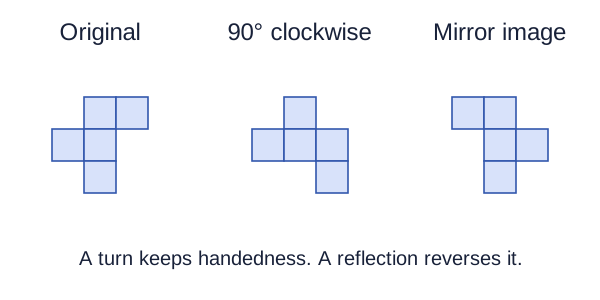
A reflection reverses a shape across a line or plane, rather than turning it around an axis. In an asymmetric flat shape, this changes the order in which its branches appear as you trace the outline. The five-square target in the diagram has a distinctive off-centre branch. Turning it keeps that branch connected in the same order; reflecting it places the branch on the opposite handed arrangement.
Do not conclude that every reflected drawing is different. A square, circle, or suitably symmetric shape can coincide with its reflection. The rotation-versus-reflection test requires a feature that actually distinguishes the two. That is why our practice uses an asymmetric target. Count the squares first, but then examine their arrangement: all four options may contain exactly five squares, while only one satisfies the transformation specified in the question.
For a three-dimensional object, a marked face can move out of sight after a valid turn. A hidden mark is not evidence that the object changed. Imagine the whole solid and keep track of which side of each joint the mark occupies. If the drawing does not supply enough information about hidden parts, avoid inventing them. A good question must constrain the shape enough for one answer to follow from the given information.
Worked example: a clockwise quarter turn
Track two arms together
Take the five-square target in the practice below. Turn the entire arrangement 90° clockwise. Its upper branch swings to the right-hand side, and the lower branch swings left. Option C preserves the full pattern. The reflection may look close, but one branch joins in the wrong order.
You can verify a flat turn with grid coordinates. On a screen grid, x increases to the right and y increases downward. A 90-degree clockwise turn maps an offset (x, y) to (-y, x). After rotating, you may translate the result so it fits inside its answer box. Translation moves the whole drawing without changing which squares touch. Keep the coordinate convention explicit; a classroom Cartesian grid with upward-positive y uses a different sign rule.
This coordinate check is a way to verify an answer, not a requirement to calculate every question. For quick visual practice, fix a landmark, picture the turn, and check a second landmark. If the two methods disagree, draw the transformed grid on paper. The discrepancy often exposes a reversed clockwise direction or an accidental reflection. A precise explanation of that mistake is more useful than immediately repeating the same item.
Moving from flat shapes to 3D objects
A flat shape turns around an axis perpendicular to its plane. A solid can turn around several axes, so the same method needs one extra discipline: decide which axis you are using at each step. Holding an imaginary corner fixed, turn one arm toward you, then check where the other arms move. Do not rotate each arm separately until it resembles the answer; that changes the object instead of its orientation.
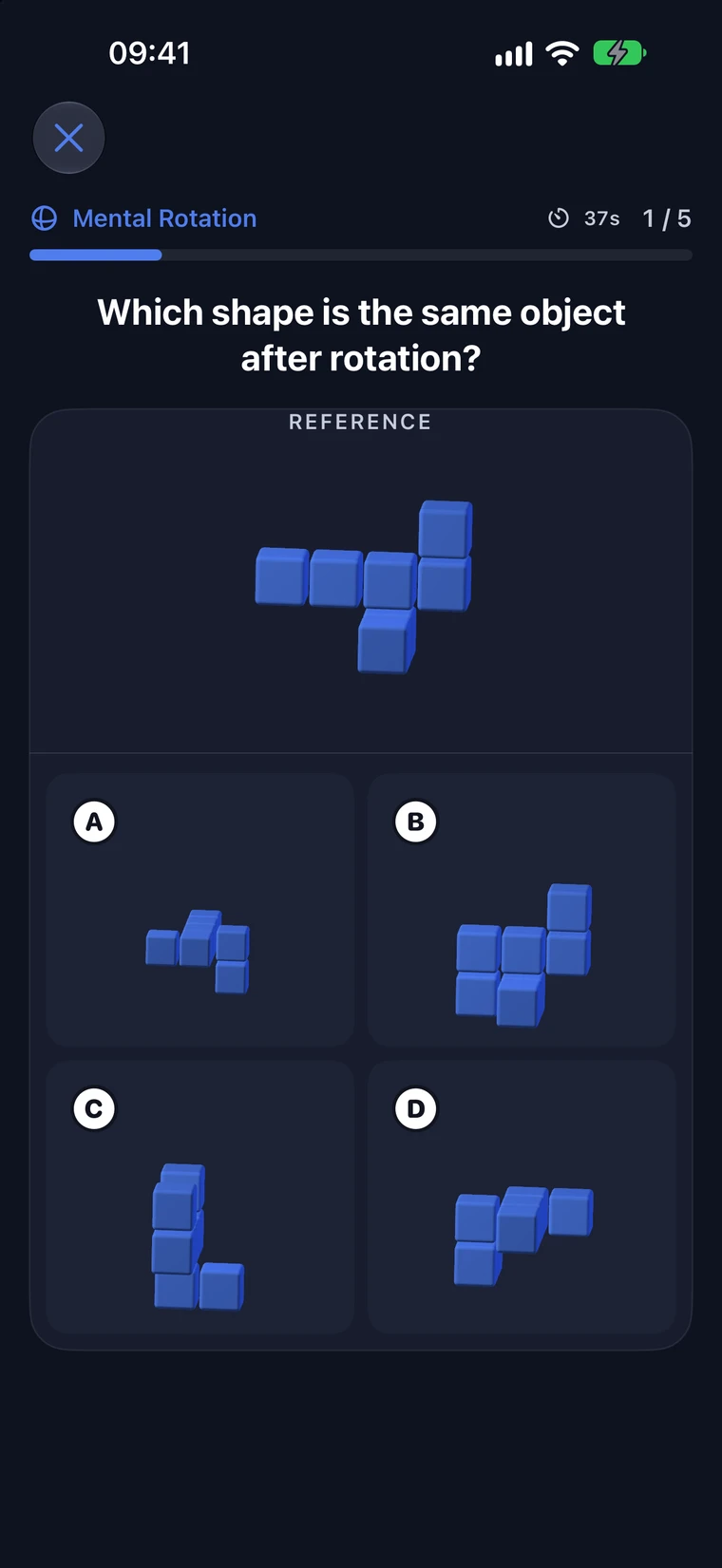
The real Foldmetry app exercise shown below uses a blue three-dimensional block object. Its useful features are the connected segments and the turns between them. One segment becoming foreshortened in the drawing does not mean it became shorter. A front-facing arm can appear almost end-on after a turn. Compare the number of connected units and the pattern of joints, then use visible faces to confirm your imagined orientation.
For labeled cubes, learn the cube net and opposite-face method first. Opposite pairs stay fixed through every rigid turn. For problems that ask what a structure looks like from a new observation point, switch to the perspective-taking guide: the object stays still while the viewer moves. These skills cooperate, but keeping the reference frame clear reduces avoidable errors.
Common mistakes and useful corrections
The first trap is matching the silhouette too early. Different solids can have the same outline from one view. Correct this by checking a joint or marked face that the silhouette does not describe. The second trap is treating a mirror as a turn. Correct this by following the order of two branches around a landmark. The third trap is changing only part of the shape. Correct this by deciding on one whole-object rotation before inspecting a choice.
A fourth trap is rushing straight to a timed score. Begin untimed and explain why the wrong alternatives fail. Only shorten the time after your method works on unfamiliar orientations. A faster answer is not a better answer if it relies on memorizing the exact picture. You can cover the choices, sketch the expected result, then reveal them to test whether your mental image was specific enough.
A short mental rotation practice routine
Spend a few minutes on one transformation at a time. Start with quarter turns of flat shapes, then half turns, then rotation-versus-reflection comparisons. Finish with one unfamiliar three-dimensional object. When you miss a question, record whether the issue was the angle, the axis, a hidden feature, or handedness. Those categories identify a useful next exercise without turning a small practice set into a claim about your intelligence.
Try the spatial ability and spatial reasoning test for a mixed set, or the non-verbal reasoning test for patterns and transformations together. These are original learning exercises with answer explanations. They do not produce standardized mental rotation scores, percentiles, or an IQ estimate. The value is seeing which method you used and whether it still works on the next shape.
Take the method into daily practice.
Foldmetry on iPhone and iPad brings six spatial skills into 36 guided lessons, daily practice, and local mistake review. Free to start, with optional Pro features.
Download on the App Store